Revisiting the outcome of the Swedish election...
Voter turnout was up, but I was surprised it only reached a measly 86.31%.
Sure, that is higher than the mere 85.14 that turned up in 2014, but given the importance of this election, give that everyone knew it was an extremely tight race, I'm really disappointed we didn't even reach 90% participation.

With overseas and voting day absentee votes included, there have been some minor shifts; the social democrats and the christian democrats have each lost one seat, while the green party and the liberals have each gained one. No shift between the two blocks though. There was also a seat that briefly shifted from the centre party to the Sweden democrats and then back again.
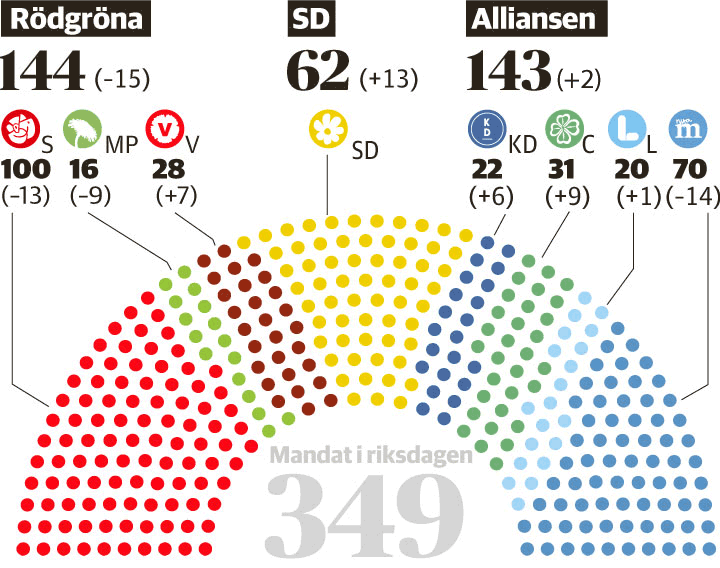
The social democrats insist that as the party holding most seats, they should form the backbone of the government, but have reached across the aisle and asked the centre party and liberals to support them and perhaps be part of a coalition government.
The alliance insists that there is a hostile majority (alliance + Sweden democrats) to the social democrats in parliament, and that they should form the backbone of the government.
This is a bit short sighted though, as the Sweden democrats have stated they will not support a government that does not give them influence, and the centre party and liberals have been very clear that they will not form part of a government that is dependent on support from the Sweden democrats.
The green party has suggested they could support a center-left government lead by Annie Lööf, leader of the centre party.
As irrelevant as this could seem, I think this could be the key to finding a working solution.
Both Annie Lööf (centre party leader) and Jan Björklund (liberal leader) have stated they will not support a government lead by Stefan Löfvén (social democratic leader).
Likewise, Stefan Löfvén has scoffed at the idea that the social democrats should support a government formed by the alliance.
But if the social democrats could be humble enough to cede the position of Prime Minister to Annie Lööf, and the centre party and liberals then join the social democrats and the green party to form a government based on broad socio-liberal ideals, they would have 167 seats, which while technically not a majority, would be more than the conservatives, christian democrats and Sweden democrats combined (154).
The left party can not be included in an across the aisle government coalition, as the centre party and liberals are almost as wary of these pseudo-communists as they are of the pseudo-nazis in the Sweden democrats, but it is not likely that the left party, that hold the remaining 28 seats, would ever even consider to join forces with either of the three parties at the right wing end of the political scale, and thus they will almost certainly let this centre-left coalition get their budget and most other legislation through parliament by either voting with them or abstain from voting. Thus they would be fairly safe. And on issues where the left party does vote against them, they can probably find support from the christian democrats or conservatives. I think this might fly.

Annie Lööf is also hugely popular even outside of her own party for being very outspoken against the Sweden democrats and taking them on more than once in verbal fist fights.
Yeah, I think this might fly.
And having the green party suggest it, takes away some of the embarassment from the social democrats and the centre party.
It will probably take weeks (if not months) of posturing before they can reach this common sense solution though.


